We recently asked the venue owners in our private group what happens at their venue to an inquiry from a few months back that never booked. Is it followed up on a schedule, checked on now and then, left sitting, or not kept at all?
That was a question for reflection, not a survey, and we're not claiming any answer is more common than another. Whichever describes you, there is one job worth doing before anyone writes to an old lead: find out what each record actually says.
Why sort first
An old inquiry list mixes very different people. Some booked with you later under a different email. Some told you no. Some asked not to be contacted. Some had an event date that has already passed. And some simply went quiet, which tells you nothing either way.
Writing to that list as a single group risks messaging someone who already booked, someone who declined, or someone who asked you to stop. Sorting first protects those people and your reputation, and shows who is genuinely worth a personal note.
Step 1: Pull a list you can finish
Choose a slice of past inquiries you can review in one or two sittings, such as one season. A short list that gets finished beats a long one that stalls halfway. Work from your own records only: inbox, CRM or inquiry spreadsheet.
Step 2: Give every record one status
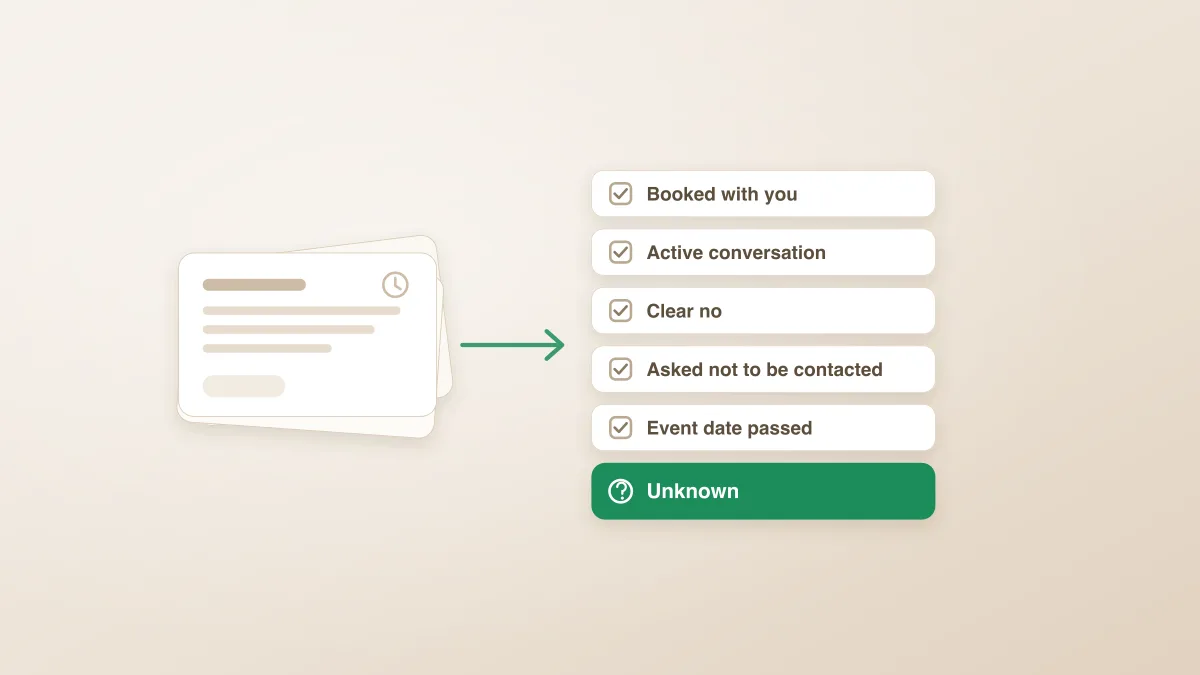
We suggest these six, and only one per record:
- Booked with you. Check by name, phone and partner name, not just email. Remove them from the review.
- Active conversation. Someone on your team is already talking to them. Leave it with that person.
- Clear no. They declined, chose another venue or cancelled their plans. Record the reason and close it.
- Asked not to be contacted. An opt-out, unsubscribe or request to stop on any channel. Record it so nobody contacts them on any channel.
- Event date passed. If the date they asked about is behind you and they didn't mention other events, close it with that reason.
- Unknown. They went quiet before deciding. This is the only status that stays open.
The important distinction is between a clear no and unknown. Silence is not a decision, but it isn't permission to keep writing either. Treat unknown as "not decided, not yet checked", nothing more.
Step 3: Check each unknown record
For each record still marked unknown, answer four questions:
- Is their event still ahead? If they gave a date or season, confirm it hasn't passed.
- How did they agree to hear from you? Note the channels they used or agreed to. If that isn't clear, don't assume.
- Do you still have what they asked about? Check the date's real status on your calendar (open, held or booked), whether the room still fits their guest count, and whether the package or pricing they saw is still current.
- Is there something new and relevant to say? For example, the date they wanted is open again, or a package now fits what they described. If not, there's no reason to write yet.
A record that passes all four goes on your short list. A record that fails any of them gets a recorded reason and stays closed.
Stop rules for the review
- Booked, declined, opted out or past date: close it and don't contact them
- Contact permission unclear: don't contact them until it is clear
- Nothing new and relevant to say: leave it, and note why
- Already contacted once after going quiet with no reply: stop
Record what you found
Add a one-line note to each record so the next person doesn't repeat the work. An illustrative note, to adapt to your own system:
Reviewed 23 Oct. Event date still ahead. Quiet since our tour offer. Email agreed at inquiry. Their date is open as of today. On short list.
If you use stages in a CRM, this is where a lost reason and a closed date earn their keep. Our guide to venue CRM pipelines covers setting them up.
Then, and only then, decide on contact
What's left may be a much shorter list of people whose event is still ahead, whose permissions are clear and who have a real reason to hear from you. What to say, and when to stop, is covered in the old-leads section of our venue inquiry follow-up guide.
Talk it through with other venue owners
Wedding & Event Venue Owners Success is our private Facebook group for venue owners. It's visible, so anyone can find it and ask to join, but only members see the discussions. You're welcome to request to join the group.
Want a second pair of eyes?
Take the free Booking Leak Calculator for an estimated booking opportunity and a practical next step.
Optional: if you'd rather talk it through, book a call to go over how your venue handles inquiries from first reply to booking.
Written by Naya B.
Venue growth strategist at Venyrs, helping event venues grow with proven marketing strategies and automation.