Many inquiries don't book from the first reply. Planning an event means comparing options, checking budgets and waiting on other people, so plenty of prospects go quiet for reasons that have nothing to do with you. Follow-up is how you stay in the conversation until they reach a real decision (yes, no or not now) without becoming the venue that sends "just checking in" every other day.
This guide starts after the first reply. If you're working on how quickly and how well you answer a new inquiry, start with our guide to venue inquiry response time.
Follow Up by Stage, Not With One Generic Sequence
A prospect who never answered your first reply needs something different from one who toured last week. Give every open inquiry a stage and follow up to match:
- No reply to your first message: repeat the date answer on a second channel if they gave you one, and make the next step easier, such as a tour link or a question they can answer in one word
- Tour booked: confirmations and reminders, covered in our venue tour guide
- Toured, undecided: the proposal or a recap, answers to what they raised on the tour, and the date you agreed to speak
- Proposal sent: check they received it, offer to walk through it on a call, and be clear about when any hold expires
- Chose another venue or the date fell through: a gracious close, and an optional question about what decided it
- Quiet for months: see old leads, below
Make Every Message Add Something
The test for each follow-up is simple: would the prospect be glad they opened it? Useful things to send include:
- An answer to a question they asked, or one people usually ask at their stage (catering rules, what's included, parking)
- Photos or a short video from a real event like theirs, used with permission
- A sample timeline or floor plan for their guest count
- Their date's status, stated honestly: open, or held for them until a stated date
- A direct question that's easy to answer, such as "Is the second Saturday in June still your first choice?"
"Just checking in" is fine as a final message. It's a weak one to lead with.
Switch Channels, Not Just Timing
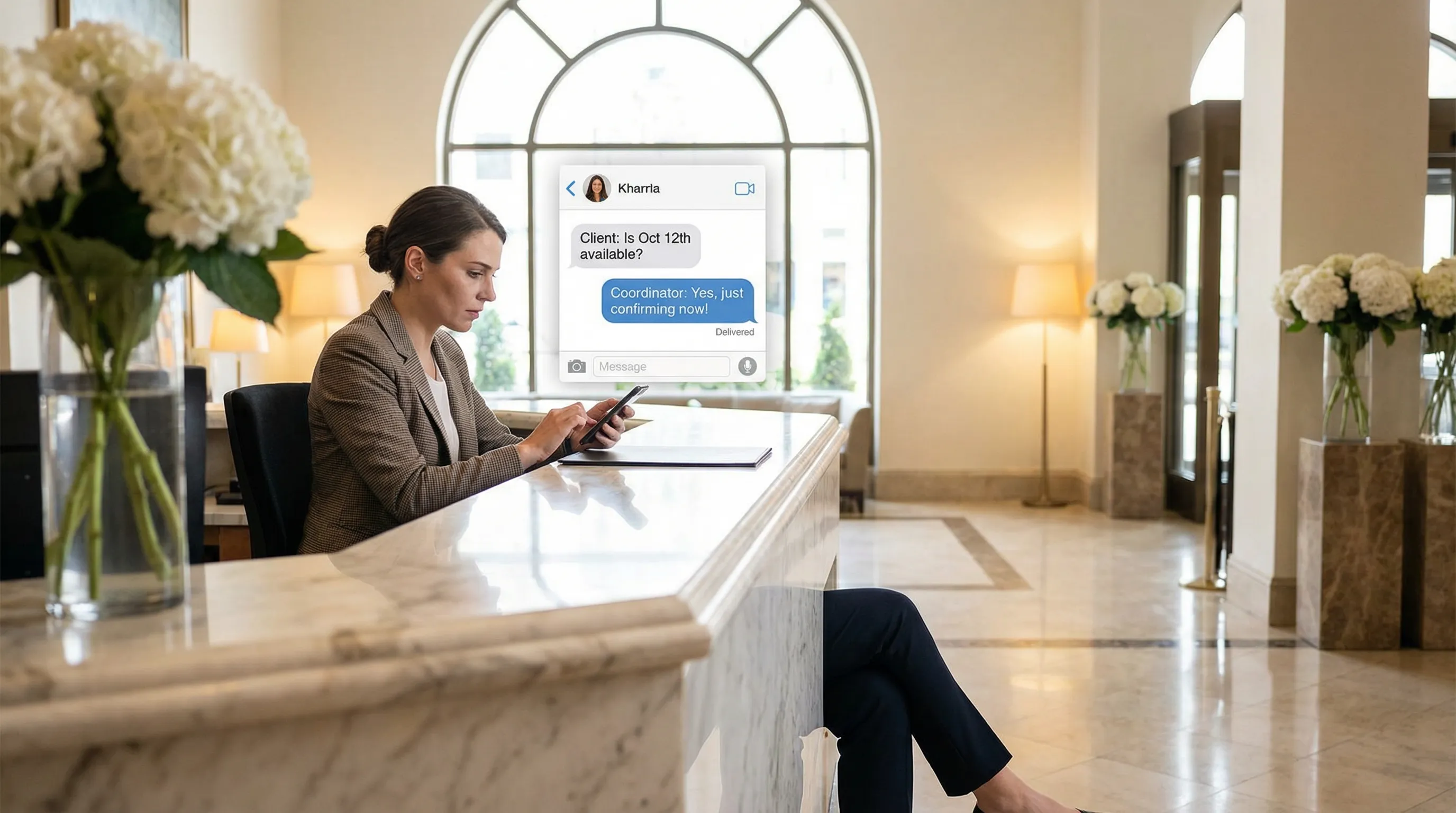
If two emails haven't worked, a third probably won't either. Try another channel the prospect agreed to be contacted on: a text if they gave you their number for that, a short call, or a reply in the channel they first used, such as Instagram or a directory inbox. A voicemail should give one clear reason to call back. Once they tell you which channel they prefer, use that one.
An Illustrative Cadence
The cadence below is an illustration, not a rule or a benchmark. Adjust the gaps to your buyers: a couple planning a wedding a year out needs a slower, longer sequence than a company booking a party for next month.
- Day 2 after the first reply, if there's no answer: a short message on a second channel repeating the date answer and the tour link
- Day 5: something useful for their event type, plus one easy question
- Day 10: a call, or a voicemail and a short message
- Day 20: a close-the-loop message (below)
Stop the sequence the moment they reply, book, say no or ask you to stop, then move them to the stage that matches their answer.
A Clear Stop Rule and a Respectful Close
Decide in advance how many messages each stage gets, and write it down so nobody keeps chasing out of guilt or gives up after one attempt. The last message closes the loop politely and leaves the door open, for example: "I haven't heard back, so I'll assume you've gone another way or the timing isn't right. If anything changes, reply here and I'll check your date." Then record a lost reason (below) and stop.
If someone asks you to stop, unsubscribes or opts out on any channel, stop all follow-up straight away and record it so nobody on your team contacts them again on any channel. Never switch to another channel to get around a request to stop.
Old Leads: Re-Contact With Care
Your inquiry history includes people who never booked anywhere, postponed, or may have another event coming up. A single relevant message can be worth sending, but only within the permissions you already have:
- Check each contact's permissions first. Only message people on channels they agreed to be contacted on, and leave out anyone who opted out or asked not to be contacted.
- Leave out anyone who has since booked with you or is already in an active conversation
- Send one personal, relevant message, such as a newly open date in their season or a package that fits what they asked about, not a campaign blast
- If there's no reply, stop. If they opt out, record it.
This is a one-off, manual review of your own records. It isn't a reason to add a new messaging tool or switch on automated re-engagement. Messaging rules vary by channel and region, so check what applies to you before you send.
Stages and Lost Reasons: Learn From Every Outcome
Follow-up only improves if you know why leads end. Keep a short, fixed list of stages (new, replied, tour booked, toured, proposal sent, deposit paid, lost) and a short list of lost reasons: date unavailable, budget, capacity, chose another venue, postponed or cancelled, no response after the full sequence, and not a real inquiry. Our CRM guide covers setting up stages in your tools; this page covers what the messages say.
A Worked Measurement (Illustrative)
The figures in this example are illustrative, not from a real venue. Replace them with your own.
Say you take the 40 inquiries from last quarter that got a first reply but didn't book a tour straight away. Your records show 14 received no further message, 18 received one or two follow-ups and 8 received the full sequence. From those three groups, 1, 3 and 3 prospects went on to book a tour, and the lost reasons show "no response" for 11 of the 14 who got no follow-up.
That doesn't prove follow-up caused the tours: prospects who got more messages may have been better fits to begin with. It does show that 14 of 40 inquiries, or 35%, received no follow-up at all. Not all of those are misses: one booked a tour anyway, and some may have declined, opted out or turned out not to be a fit. Check each of the 14 and count only the ones that were still open and eligible for follow-up. Those are the process gap to close first; then compare next quarter's numbers.
Follow-Up Checklist
- Give every open inquiry a stage
- Write one useful follow-up for each stage, in your own words
- Use a second channel only where the prospect has agreed to it
- Set a stop rule for each stage and a close-the-loop message
- Honour opt-outs immediately, on every channel
- Record a lost reason for every closed lead
- Review old leads manually, within existing permissions, one message each
- Each month, count how many inquiries got no follow-up at all
When Outside Help Makes Sense
Follow-up is usually the first thing to slip when the team is busy with events. A managed booking department that handles inquiry response, follow-up and tour scheduling can fit when your venue is presentable and accurately priced, with meaningful open dates and room for more events, but follow-up keeps fading after a message or two. It isn't the right step yet if you're still resolving licensing, construction, pricing, photography or basic service issues; more inquiries won't fix those. Our results page shows the inquiry-to-payment funnel for one real venue.
If you'd like to know where your own pipeline leaks first, a Venue Booking Leak Audit is a 20-minute call where we map your inquiry-to-deposit funnel, identify the largest leak, estimate its monthly value, and recommend the operating model that fits, including when that model is your own team.
Written by Naya B.
Venue growth strategist at Venyrs — helping event venues grow with proven marketing strategies and automation.